
SEO Insights
SEO Tips for 2026
Practical Strategies That Still Drive Rankings, Visibility, and Real Business Growth
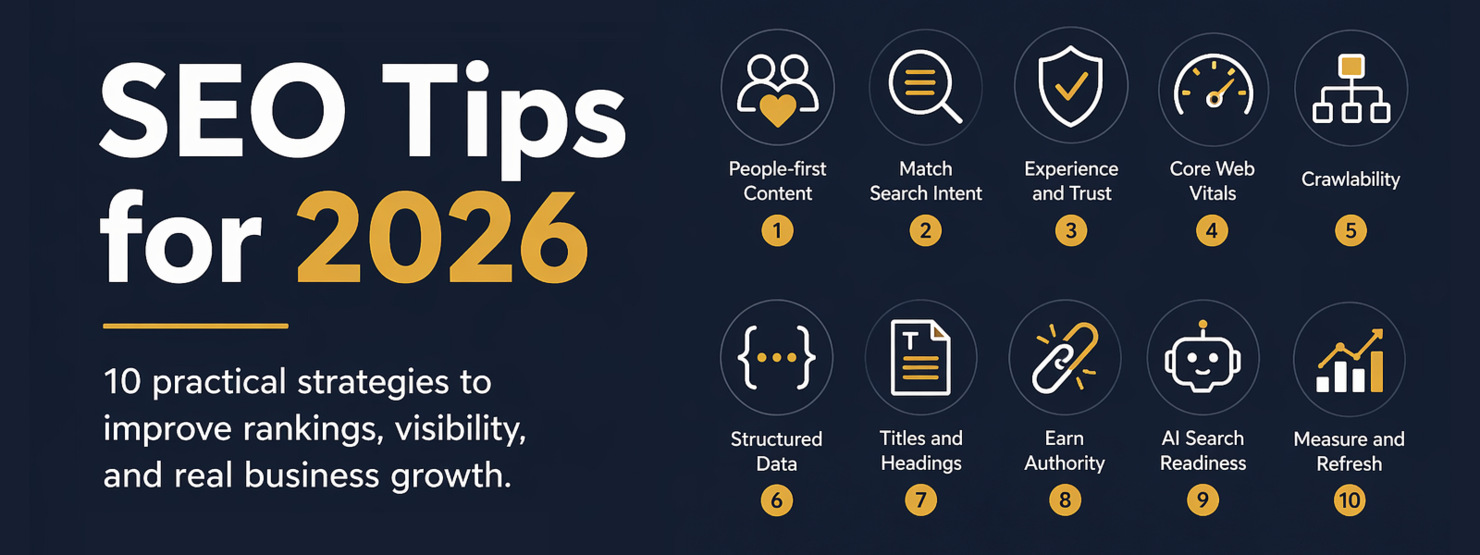
SEO in 2026 is no longer about shortcuts, isolated tricks, or chasing every new trend. The brands that win are the ones that build strong websites, publish helpful content, satisfy real search intent, and create trust across every touchpoint. In this guide, we expand on the core principles behind our infographic and show what businesses should actually focus on if they want SEO to deliver measurable results.
At Goldeon, we treat SEO as a growth system, not just a rankings service. That means connecting technical SEO, content strategy, UX, conversion thinking, and long-term authority building into one practical framework.
1. Create people-first content
One of the biggest mistakes businesses still make is producing content primarily for search engines instead of for users. Google has become far better at understanding quality, usefulness, and intent, and AI-driven search experiences are pushing this even further. Thin, repetitive, over-optimized content may still appear in search temporarily, but it rarely sustains visibility or builds brand trust.
People-first content starts with understanding what your audience actually needs to know. That could mean answering practical questions, comparing options, explaining processes clearly, or helping a potential customer make a better decision. The content should feel like it was written by someone who understands the topic, not by someone trying to force keywords into paragraphs.
In practice, this means writing original copy, adding real examples, using clear structure, and removing fluff. It also means improving older content that no longer meets modern expectations. If a page is not genuinely helpful, SEO alone will not save it for long.
2. Match search intent precisely
Ranking well is not just about choosing the right keyword. It is about understanding what the user expects to see when they search that keyword. Some queries are informational. Some are transactional. Some are navigational. Some are local. If your page does not match that expectation, it will struggle to perform, even if it is technically optimized.
For example, someone searching for “best sulfate-free shampoo” likely wants a comparison, recommendations, and maybe buying guidance. Someone searching for a brand name may expect a category page. Someone searching for a service in a city may need a strong local landing page with trust signals and clear contact information.
Before optimizing any page, ask a simple question: what is Google already rewarding for this query, and why? The answer often reveals the ideal content format, the depth required, and the type of CTA that should appear on the page.
3. Show experience and trust
Trust has always mattered in SEO, but in 2026 it matters even more. Search engines and users both want signals that show credibility: expert input, clear authorship, transparent business information, real references, and content that reflects genuine knowledge of the subject.
This does not mean every business needs academic citations everywhere. It means your website should feel trustworthy. Your About page should be clear. Your service pages should be specific. Your case studies should be real. Your testimonials should feel authentic. Your content should reflect actual experience, not generic paraphrased information.
For service businesses especially, trust signals can be the difference between impressions and conversions. Strong SEO visibility matters, but it becomes much more powerful when supported by business credibility, proof of work, and clear positioning.
4. Improve Core Web Vitals and page experience
Speed and usability are not “nice extras.” They are part of modern SEO performance. If a site feels slow, unstable, or frustrating, both users and search engines notice. Core Web Vitals remain important because they measure real experience: how quickly a page loads meaningful content, how stable the layout is, and how responsive the interface feels.
But page experience is broader than metrics alone. A fast page with poor hierarchy, intrusive elements, weak mobile UX, or confusing structure will still underperform. That is why technical optimization should always be connected to UX thinking.
In practical terms, businesses should optimize images, reduce unnecessary scripts, improve server performance, simplify layouts, and make sure the mobile experience is smooth. A technically strong site creates the conditions for content and SEO strategy to perform at full strength.
5. Make your site easy to crawl and understand
Search engines cannot rank what they cannot properly access, interpret, and connect. Crawlability is still fundamental. That means clean site structure, logical internal linking, indexable pages where needed, accurate canonicals, and technical clarity across the entire website.
Many businesses lose visibility not because their content is bad, but because their website architecture is confusing. Pages compete with each other, important sections are buried too deep, internal linking is weak, or low-value URLs dilute the overall structure.
A well-organized site helps both users and search engines. Important pages should be easy to reach, category structures should make sense, and internal links should reinforce topical relationships. Good SEO often begins with making the site more logical, not more complicated.
If your content doesn’t clearly answer a search query within the first few seconds, rankings won’t matter — users will leave.
6. Use structured data correctly
Structured data remains one of the most misunderstood parts of SEO. Some businesses overuse it. Others ignore it. The goal is not to add every schema type possible. The goal is to use relevant structured data that accurately reflects visible page content and helps search engines understand entities, relationships, and page purpose.
Product pages, service pages, articles, FAQs, organizations, breadcrumbs, and reviews can all benefit from correct schema implementation when used thoughtfully. But structured data should support clarity, not replace it. If the page itself is weak, schema will not magically create SEO success.
Use it where it makes sense, validate it properly, and keep it aligned with the real page content. That is where its long-term value comes from.
7. Optimize titles, headings, and on-page structure
Titles and headings still matter because they guide both users and search engines. But in 2026, optimization needs to be more natural and more strategic. Over-optimized titles no longer impress anyone. Clear, relevant, human-friendly titles perform better because they align with how people actually search and click.
A strong title should communicate relevance and value. A strong heading structure should improve readability and make the page easy to scan. Good on-page structure supports engagement, reduces confusion, and helps important information stand out.
This also extends to elements like image alt text, product names, section labels, and supporting copy. Small improvements across on-page structure often create surprisingly strong cumulative SEO gains.
8. Earn authority naturally
Authority building is still essential, but the approach needs to be cleaner and more sustainable. Search engines are better at recognizing patterns that feel manipulated. That means low-quality links, random directory submissions, and artificial tactics are far less effective than they once were.
Real authority comes from things like useful content, brand mentions, PR, partnerships, digital assets worth referencing, and a website that deserves to be cited. Link building still matters, but the standard is higher: the links should make sense in context and contribute to genuine brand strength.
The best authority strategies often grow out of quality content, strong positioning, and consistent business activity. In other words, authority is not just built off-site. It is earned through the total quality of your digital presence.
9. Prepare for AI-driven search
AI search does not replace SEO. It changes how SEO needs to be structured. More answers are now summarized, rewritten, and surfaced through AI systems that prefer clarity, entity consistency, trust, and well-structured information. If your content is vague, bloated, or poorly organized, it becomes harder for these systems to interpret and surface.
Businesses should create content that answers real questions directly, uses logical structure, supports context with clear subheadings, and reinforces expertise through strong topical consistency. FAQ blocks, comparison content, glossary-style explanations, and well-structured service pages all become more valuable in this environment.
AI-ready content is not robotic content. It is content that is easier to understand, easier to extract meaning from, and easier to trust.
10. Measure performance and refresh what matters
SEO is not something you “finish.” It needs regular measurement, interpretation, and refinement. Rankings, clicks, impressions, CTR, page performance, user behavior, and conversions all tell part of the story. The real value comes from connecting those signals and using them to improve the pages that matter most.
Some pages may need title updates. Some may need stronger internal links. Some may need better UX, fresher content, or a clearer CTA. The businesses that keep winning are usually the ones that treat SEO as an active performance channel, not a one-time setup task.
Refreshing existing winners is often faster and more profitable than constantly publishing new content. Smart SEO growth comes from improving what is already close to breaking through, while continuing to strengthen the broader system.
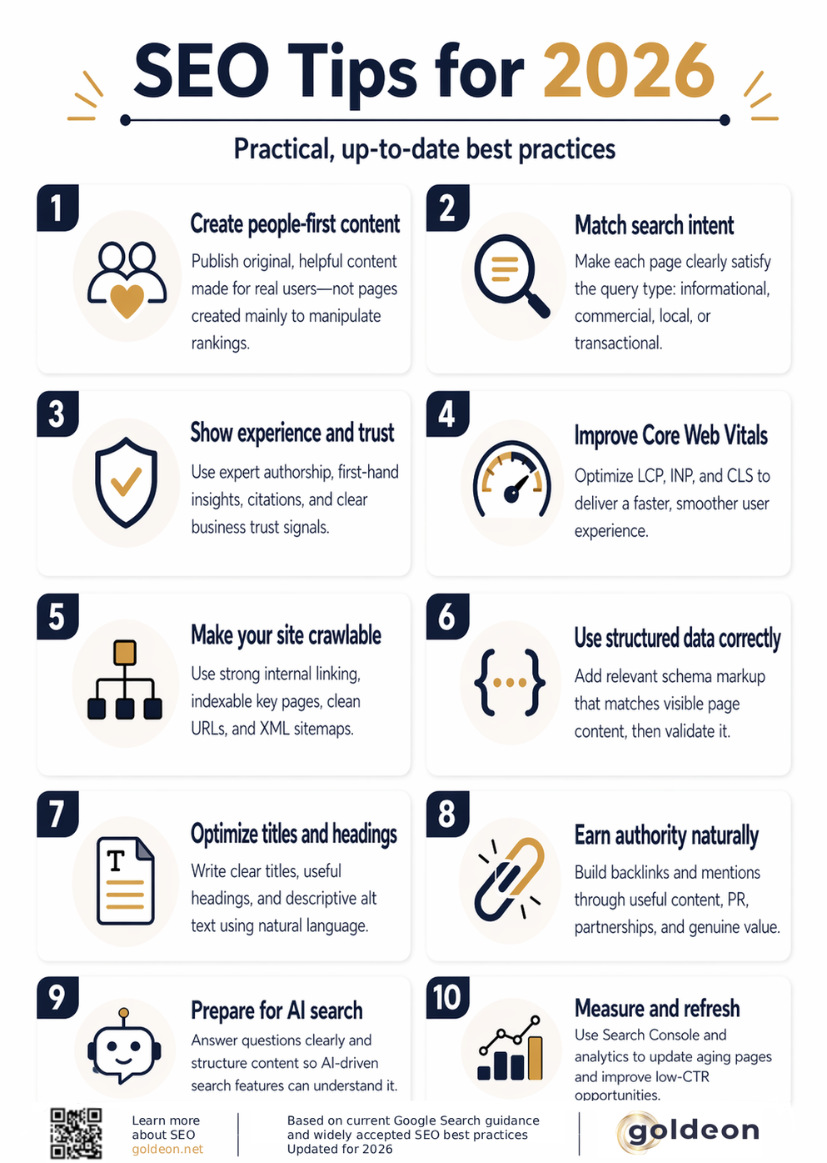
Want a quick, actionable SEO checklist?
Use this visual framework to audit your website and identify missed SEO opportunities in minutes.
Final takeaway
The fundamentals still work, but the standard is higher. In 2026, successful SEO requires better content, sharper intent targeting, stronger technical foundations, clearer trust signals, and a website that turns visibility into business results. The brands that approach SEO strategically will keep compounding their advantage.
Need help applying this to your business?
If you want to go beyond generic SEO advice and build a strategy that improves visibility, traffic, and real business growth, we can help.
0 Comments